

When looking at the craft behind the experiences at food and entertainment venues, the complexity of architecture and spatial design can often be overlooked. In the span of two decades, alongside the rise of Gen Z’s, Neuroaesthetics has solidified its importance in the realm of design.
The term Neuroaesthetics was coined in 1999 by neuroscientist, Semir Zeki, who proposed that there is true correlation between the biological experience of humans and their visual surroundings. Whether it be a connection between tangible objects, artefacts, or environments, these sensorial experiences can trigger neurological responses within the human brain, leading to the case of certain moods and emotional outcomes.
The concept of Neuroaesthetics, when explored by architects today, is incorporated subtly in the details of everyday design. “We never think of a spider without its web, but somehow, we think humans exist without all this other stuff around us,” Suchi Reddy mentions in an interview.
The Reddymade founder took inspiration from her outlook towards her homebase in India, now building immersive spaces that reflects her philosophy: ‘Form follows feeling’, making the invisible visible, and how aligning with spatial flow can nurture our wellbeing.
“When I first started my career, much of the conversation was about style—what’s fashionable, what’s trending. But style can be exclusionary, as it puts people into categories. I’ve always been more interested in how design impacts the body and the mind, because that experience is shared by all of us, and that’s why I was bringing the language back,” Reddy states in an interview with Design Pataki.
In Reddy’s own projects, she conjures the emotions of her clients within the space she’s working with – incorporating each delicate personality into texture, space, and natural lighting. Having worked frequently with residential lots, her projects are a blend of warmth, personal detail, and emotion-evoking designs that reflect not only the nature of the space, but the inhabitants.
“There’s a huge group of people working in this field—environmental psychologists, cognitive scientists, artists, architects, designers—thinking about how your environment triggers, acts upon, and influences your brain and your body. And that could be anything. It could be an artistic experience or aesthetic experience. It could be a space.” She tells Ann Binlot in an interview for Document Journal.
How Spatial Psychology Is Served In Restaurants
Projects that implement the idea of Neuroaesthetics have been explored through several architectures in F&B. To earn strong credentials in the food industry means providing a well-rounded, purpose-driven experience, which now includes elements beyond taste palates and food ingredients. Restaurants in the modern era are striving to build spaces that elevate guest experiences, while also including strong cohesion between brand identity and spatial design.
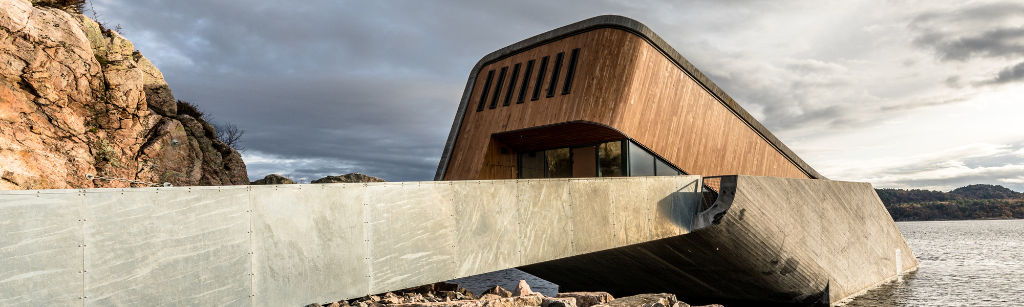
Under, Europe’s first underwater restaurant opened its doors in Norway, playing with the dual meaning of the Norwegian word “under”, which translates to both ‘below’ and ‘wonder’. The restaurant’s structure – spanning 34 metres – tilts into the sea, presenting a half-sunken project resting five metres below sea level.
Designed by Snøhetta, a renowned architecture firm founded in Norway, the restaurant is built to withstand the harsh conditions of the North Sea. Thick concrete slabs are used to hold out against water pressure, cementing itself into the southernmost coastline of Norway. The restaurant also functions as a research centre, observing the natural occurrences of biodiversity as the structure becomes one with a variety of aquatic species flourishing within its surroundings.
Drawing from its dedication to sustaining marine life, Under extends this philosophy into its fine dining experience. With a focus on high quality local produce, the kitchen serves fresh sea ingredients right on the seabed – committing to the explicit use of sustainably-captured wildlife for each of its courses. With Nicolai Ellitsgaard as the head chef, an international kitchen team experiments with palates from both the land and sea for guests to enjoy, while also immersing in authentic marine life.
Tying into the notions of Neuroaesthetics, Under crafts a sophisticated link between culinary direction and architectural design. As the plates exhibit deliberate themes of sustainability through natural and organic ingredients, the design embodies an artificial reef – establishing a strong dialogue between product and experience.
On the other hand, the interior – covered in wooden finishes, oak-clad furniture and a blend of soft and hard textiles instils a calm ambience, replicating the feeling of being peacefully submerged underwater. The details are chosen thoroughly, with chairs only made from locally harvested Norwegian oak, mimicking the natural structures of tree roots. Allowing a limited amount of 40 seats, guests enjoy views depending on the exclusive colours of each season, as gradients shift from light blue during cold winters to a crystal-clear green during the hot summer – these complex design choices create alignment between the consumed and the observed, crafting the perfect gastronomical memory for visitors willing to travel the long car ride.
Philosophy vs. Intimacy – Potong’s Approach to Embodying Concepts Through Space
Some restaurants explore design through culture, rather than its culinary themes. Potong is a fine example of a project that takes guests on the intimate journey of the chef, a heartwarming personal story told through architecture itself.
‘Potong’ is the name of Chef Pam Soontornyakij’s family-owned traditional Chinese pharmacy, running since 1910. Over the course of a 100 years, Chef Pam’s family sold Chinese herbal medicine, based in a 5-story-tall Sino-Portuguese building, passing through 4 generations – a historic site in which was later converted to what is now known as one of the most popular fine-dining locations in Bangkok, Thailand.
Set in the ancient, rustic surroundings of Bangkok’s Chinatown, Potong’s building was renovated to preserve its originality, but challenged with the task to fit all modern kitchenware and concepts into tiny shafts within the structure, carried through a preserved built-in elevator planted in the heart of the building. The restaurant became a long-term restoration project, toying with the contrast of time: the old and the new. The beauty of 100-year-old hard wood ceilings blended with modern lighting and carved wood fosters a charming contrast created by its architects – the building evokes a constant conversation between past and present.
The restaurant showcases meticulous storytelling through each distinct levels, all showing its own character – from the remnants of the pharmacy-converted bar to the intimate main dining room, which encourages guests to connect not only with history, but renovation, as they move along the space. By placing traditional and modern elements in such proximity, Potong allows guests to breathe in recollection and the warmth within what once was a family home, while indulging in a 20-course tasting menu that reflects Chef Pam’s historical roots.
This environment does more than engage storytelling, it sculpts a memory that plays back, while also keeping the present memorable. The five-story building has become a narrative space that embodies the chef’s very own personal memory, culture and perception.
Ultraviolet: The Engineer of Immersion
Another mode of modern-day Neuroaesthetic is to engage technology for an enhanced experience within a space; Ultraviolet marks a great example in visionary fine-dining. Chef Paul Pairet pushes beyond the limitations of à la carte dining through the perception of food, achieving three Michelin stars and Asia’s Art of Hospitality Award by 2017 through his exploration of these innovative concepts. Pairet choreographs the element of light, sound, and scent to fix certain perceptions on taste palates, defying the conventions of the typical dining room in luxury restaurants.
Built in a minimal room painted in all white, every design element is crafted with the use of technology. The exclusive 10-seat restaurant invites visitors to an old warehouse that completely transforms into its very own universe through 56 speakers, 7 high-resolution projectors and multiple diffusers, for a full-on sensory experience.
Through each course, a curation of audio, lighting and customised scents paints the landscape of each serving – merging the connection between space and flavour. This multi-sensory experience makes Ultraviolet one of the key disrupters in the food and design space, going beyond traditional architecture and reaching for present-day advancements to amplify psychological engagement. Transcending the boundaries of many fine dining projects, the restaurant further proves that enjoying culinary work doesn’t stop at taste.
A New Taste in Dining Spaces
The movement towards Neuroaesthetics within the restaurant industry raises the bar on how we approach food culture, and the importance of purposeful architecture. The way we consume fine dining now focuses not only on the craft of flavour, but the experience that surrounds it. From spatial storytelling to strong, cohesive designs, these stylistic choices are what reframes the appeal of a dining space to the modern consumer.
When restaurants consider how intention-driven architecture can influence one’s mental experience as explored in Neuroaesthetics – another layer of depth is added into culinary culture. Today’s restaurateurs now have more than just flavour to craft and design. “We all process space through the same instrument—the body—regardless of our backgrounds, memories, or cultural experiences. Of course, our personal memories can shape our emotional responses to design, and that can sometimes diverge from collective or universal reactions,” Reddy shares her take on processing space with Design Pataki.
From basic floor planning to the varying use of textures, the way a space is designed is proven to stimulate the senses, the body and the mind – and some experiences, depending on the space, may have a longer-lasting imprint than others. Those memorable moments that bind true connection could be what some may call a rich experience. “At the core, we are all affected by space in embodied ways: through our senses, through how a space makes us feel physically and emotionally. To me, that’s the true meaning of luxury—not opulence, but a feeling of connection and awe that’s accessible to anyone.”
BurdaLuxury’s Lens
Although architecture and its link to psychological experience may seem intuitive to some, the creation of more nuanced and delicate designs is what truly separates refined creations from basic, surface-level aesthetics. For restaurants, revising the most minute design details can significantly elevate the standards of experience, thus putting some locations in the top percentile. Going the extra mile does more than making a mark – it delivers passion, intention, and commitment to one’s culinary direction: a deciding factor of what really makes a dining space worthwhile.